
It is, in fact, thusly quite appropriate that, when apostate man discovers that his purely rationalistic ideal of knowledge—complete adequation of thought and being—leads to the loss of his own identity, he should turn, in desperation, and instinctively, to the idea of pure irrationalism, asserting that no one may know ultimate reality anyway. By claiming to know ultimate reality, or even anything about it, we are then told, would signify bringing this ultimate reality down into the realm of flux.
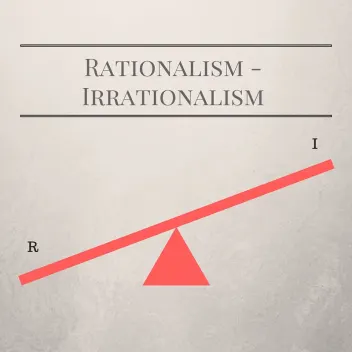
Such “pure irrationalism,” however, cannot be maintained, except as the dialectical counterpart of “pure rationalism.” To say, with the irrationalist, that no man may know anything about ultimate reality is, in effect, to claim absolute knowledge of absolute reality. Thus it is that the apostate man see-saws back and forth between pure rationalism and pure irrationalism without ever coming to rest.
. . . The fulcrum for both the modern and the Greek dialectical see-saw, between pure rationalism and pure irrationalism, is, as earlier, noted, the would-be autonomous man. If man refuses to see himself as a creature of God, or, more pertinently, as a sinner rescued by Christ, then he will quite naturally continue to go up and down, up and down, on this see-saw. When the rationalist is up, he proposes to have defeated the irrationalist. When the irrationalist is up, it is the reverse. But, if this spectacle were not enough to frighten you, then think of the fact that “the rationalist” and “the irrationalist” are really not separately existing entities at all, but rather, opposite, co-existing aspects of the one and indivisible would-be self-sufficient homo sapiens.
– Cornelius Van Til, Who Do You Say That I Am? p.24
Read more https://corneliusvantil.wordpress.com/2016/07/18/the-see-saw-of-autonomous-man/